
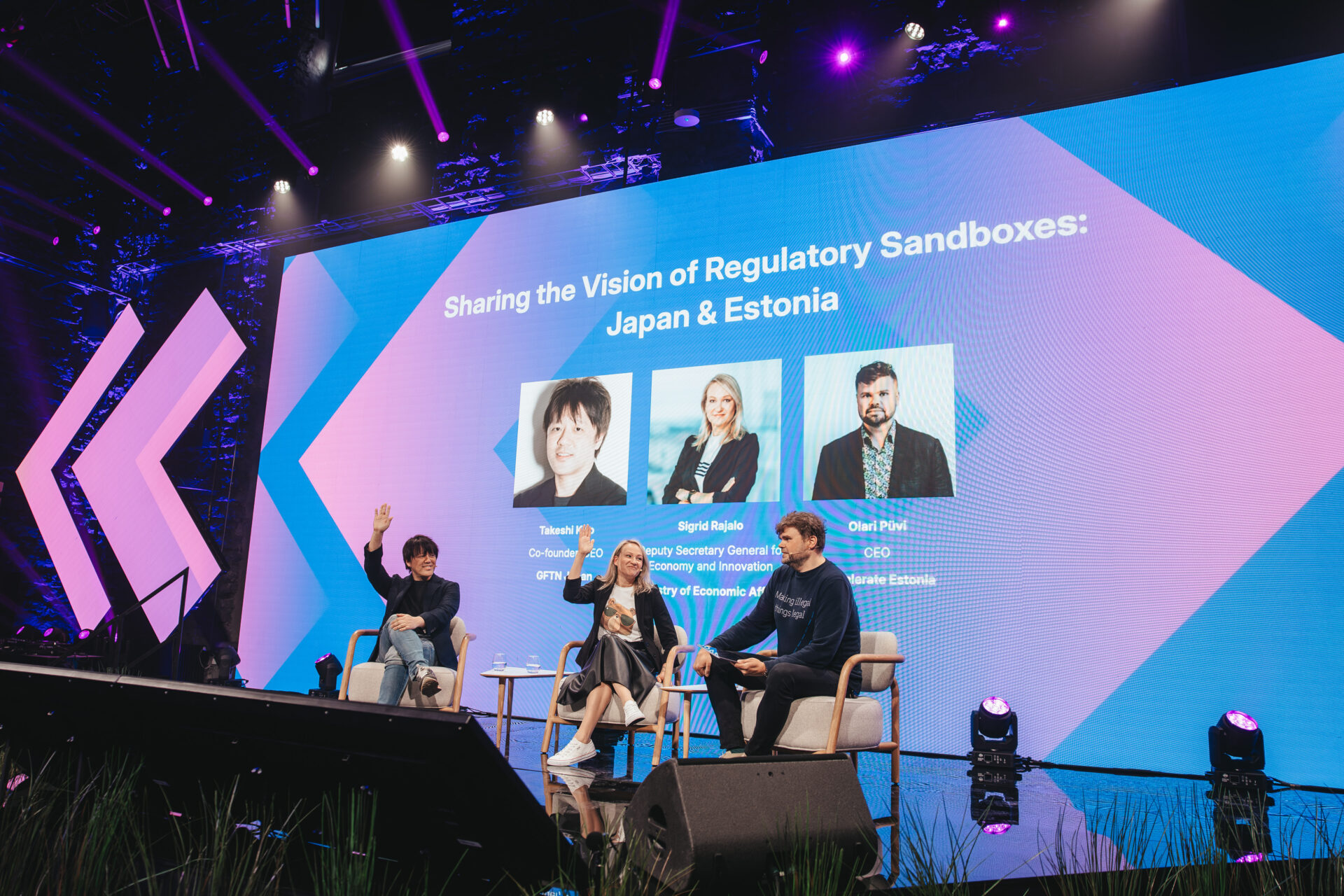
We kicked off Latitude59 this year by co-organising the official opening event, Thinking in Billions, alongside Latitude59. The event brought together international experts, founders, and policymakers to discuss a central challenge: how to overcome legal barriers so breakthrough technologies can safely reach the market. The core takeaway from the stage was clear: bringing real innovation to market requires both governments and companies to be ready to test new solutions in a controlled environment, ensuring legal frameworks keep pace with technological development.
Key insights:
- Canada’s Minister of Foreign Affairs, Anita Anand, delivered an address emphasising the need for international cooperation and risk-taking in today’s changing global landscape. “We thrive when we learn from each other and don’t assume we have all the answers,” she noted, strengthening the bonds between Canada and Estonia in startup ecosystems, AI, and cybersecurity.
- Sigrid Rajalo, Deputy Secretary General for Economy and Innovation of the Ministry of Economic Affairs and Communications, highlighted the role of regulatory sandboxes. She introduced the mechanics of Estonia’s experimentation framework that will provide high-impact, high-friction companies a clear, linear path to test innovations in the real world. “Through a testing environment, we are creating a clear and safe way for companies and the state to test complex technologies and solutions with high potential impact,” she stated, explaining that future rules should be shaped by real data and experiments rather than assumptions.
- Takeshi Kito, co-founder and CEO of GFTN Japan, shared how he, as a fintech entrepreneur, worked to get his business regulated in Japan. After successfully navigating those regulatory gaps, he was invited to sit on the other side of the table to help design and operate Japan’s own regulatory sandbox. He also pointed out the close alignment between Estonian and Japanese regulatory sandboxes, which could lead to future cross-border collaborations.
- Participants on the startups and investors panel noted that changing outdated regulations is critical to accelerating innovation. Leo Ringer, founding partner at UK-based Form Ventures, praised the Estonian approach: “The question of how we get the best of innovation in complex, regulated markets should be a central economic and social policy question. Estonia has long led the way when it comes to regulatory innovation.”
- Representatives from global platforms Bolt and Wolt shared their experiences navigating highly regulated markets and the next logical frontier: delivering over-the-counter (OTC) medicines straight to doorsteps. Triin Toimetaja, Strategy & Operations Manager at Bolt, emphasized that to maintain its digital reputation, Estonia’s regulations must move as fast as technology, stressing the importance of businesses and the public sector jointly designing solutions.
- The day concluded with a public sector panel discussing how to overcome one of the biggest practical obstacles to implementing innovation in government: situations where public sector leaders avoid making necessary decisions out of fear for their careers. Tõnis Tänav, Deputy Secretary General at the Ministry of Regional Affairs and Agriculture, challenged the current status quo: “The current risk and reward system really does not incentivise the public sector enough to force them to take great leaps. Maybe it should be the other way, losing your job for not being innovative enough?”
Thinking in Billions 2026 was the official opening event of Latitude59. The event took place on 20 May 2026 at Kultuurikatel and was organised by Latitude59 in partnership with Accelerate Estonia and the Ministry of Economic Affairs and Communications.
Photos of the event can be accessed here.